Canada Child Benefit (CCB) 2026: Your Complete Guide
Everything you need to know about maximizing your tax-free monthly payments for raising kids in Canada
How Much Can You Get from CCB in 2026?
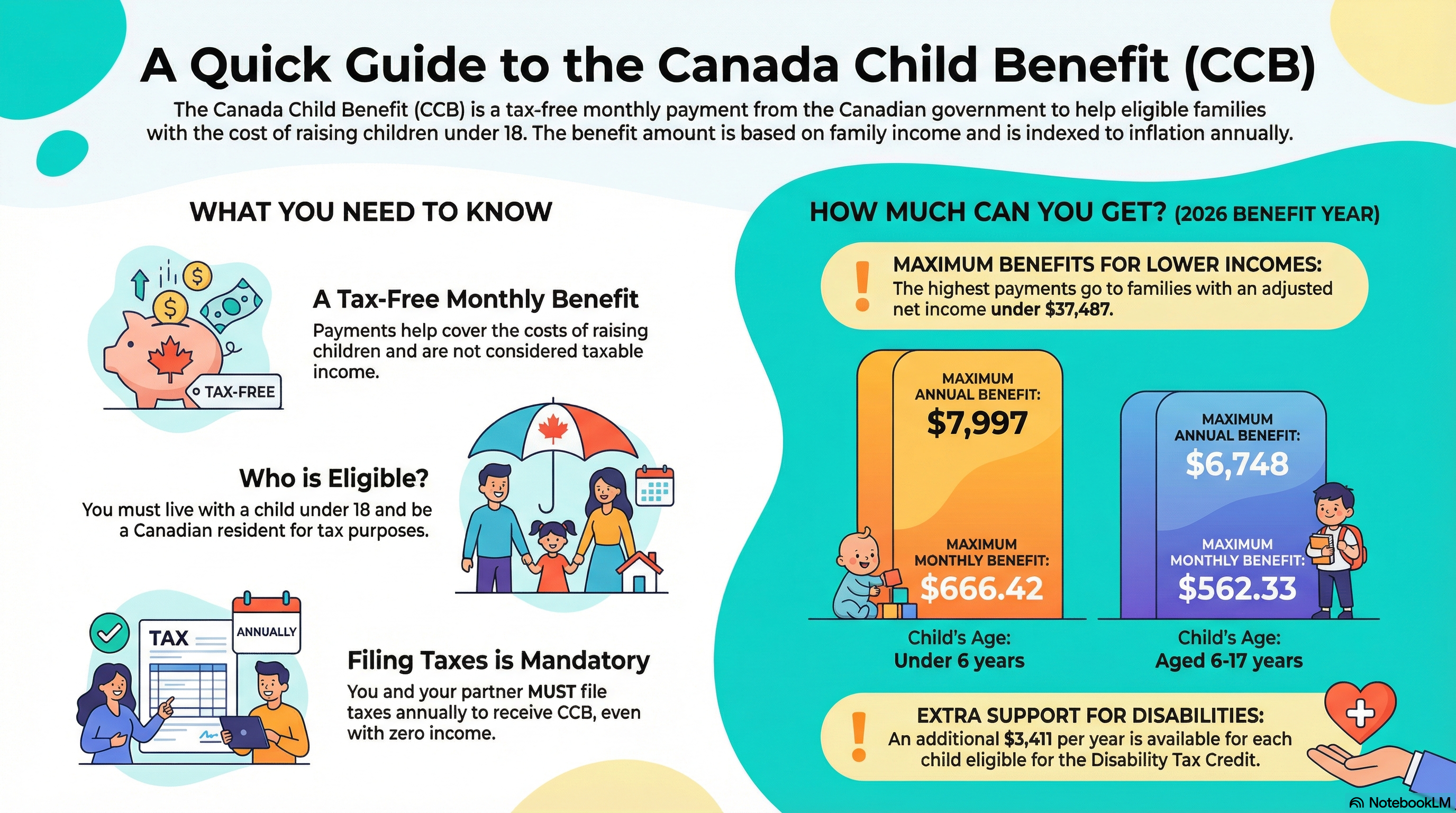
Quick Answer: 2026 Maximum Benefits
For children under 6: Up to $7,997 per year ($666.42 monthly)
For children aged 6-17: Up to $6,748 per year ($562.33 monthly)
Income threshold for maximum benefit: Adjusted family net income under $37,487
Let's be real—raising kids in Canada isn't cheap, eh? Between hockey gear, school supplies, and groceries that seem to cost more every month, parents need all the help they can get. That's where the Canada Child Benefit comes in clutch. This isn't just another government program gathering dust—it's actual money deposited into your account every single month, tax-free.
The CCB was introduced back in 2016, replacing older programs that frankly weren't cutting it anymore. What makes this benefit special? It's indexed to inflation annually, meaning as living costs climb, your benefit amount climbs too. For the July 2025 to June 2026 payment period, families saw roughly a $200 increase per child compared to the previous year—and that's not pocket change when you're budgeting for a family.
Who Qualifies for the Canada Child Benefit?
Here's the thing—you might qualify even if you think your income is too high. The eligibility criteria are more flexible than many folks realize. You need to meet these basic requirements: live with a child under 18, be primarily responsible for their care and upbringing, and be a Canadian resident for tax purposes.
Your immigration status matters, but there's good news for newcomers. You can qualify if you're a Canadian citizen, permanent resident, protected person (including refugees), or even a temporary resident who's lived in Canada for at least 18 months with a valid permit. That last bit is crucial for families who've recently arrived—don't assume you're not eligible just because you're not a citizen yet.
Tax-Free Income
Every dollar you receive is yours to keep—no reporting required on your tax return
Monthly Payments
Consistent deposits on the 20th of each month help with budgeting and planning
Inflation-Indexed
Benefits automatically increase each July based on the Consumer Price Index
Family-Focused
Higher benefits for younger children and additional support for disabilities
Understanding Your Adjusted Family Net Income (AFNI)
This is where things get interesting—and potentially confusing. Your benefit amount isn't just about your gross salary; it's calculated using something called adjusted family net income, or AFNI. Think of AFNI as your household's total net income (that's line 23600 on your tax return) with a few tweaks.
The CRA starts with your family net income, then subtracts any Universal Child Care Benefit or Registered Disability Savings Plan amounts you received, and adds back any repayments you made. If your AFNI is under $37,487, you'll get the maximum amount for each child. Once you cross that threshold, your benefit gradually decreases—but don't panic, you still get something unless you're earning well into six figures.
Here's the kicker that catches people off guard: the income used for your 2026 benefits comes from your 2025 tax return. So if you had a rough year financially in 2025, your 2026 CCB payments could actually be higher. On the flip side, if you scored a big raise or bonus, expect your next year's benefits to adjust downward. This lag can work in your favor if you plan strategically.
How the Payment Reduction Works
| Number of Children | First Reduction Rate | Second Reduction Rate |
|---|---|---|
| 1 child | 7% ($37,487 - $81,222) | 3.2% (over $81,222) |
| 2 children | 13.5% ($37,487 - $81,222) | 5.7% (over $81,222) |
| 3 children | 19% ($37,487 - $81,222) | 8% (over $81,222) |
| 4+ children | 23% ($37,487 - $81,222) | 9.5% (over $81,222) |
The reduction rates increase with more children, which might seem counterintuitive at first. Why would families with more kids lose more of their benefit? It's because they're starting from a much higher total benefit amount. A family with four kids getting the maximum would receive nearly $32,000 annually—so even with steeper reductions, they're still receiving substantial support.
Child Disability Benefit: Extra Support When You Need It
If your child qualifies for the Disability Tax Credit, you're automatically eligible for the Child Disability Benefit on top of your regular CCB. For 2026, that's an additional $3,411 per year ($284.25 monthly) per eligible child. The best part? If your child already has DTC approval, the CDB kicks in automatically—no separate application needed.
This additional support recognizes the extra costs families face when raising a child with disabilities, from specialized equipment to therapy sessions that aren't covered elsewhere. And because it's rolled into your monthly CCB payment, you don't have to juggle multiple payment schedules or programs.
Payment Dates and How to Track Your Benefits
Mark the 20th of each month on your calendar—that's when CCB payments land. If the 20th falls on a weekend or statutory holiday, you'll get paid on the last business day before. Set up direct deposit through your CRA My Account so you're not waiting around for cheques in the mail.
Want to know exactly what's coming? Log into your CRA account or download the MyBenefits CRA mobile app. You'll see your upcoming payment amounts, payment history, and any notices about changes to your benefit. It's honestly worth checking quarterly, especially if your family situation has changed—had another baby, got separated, income shifted significantly.
Calculate Your Exact Benefit Amount
Not sure what you'll receive? Use the CRA's official calculator to get a personalized estimate based on your family's situation.
Calculate My CCB →How to Apply for the Canada Child Benefit
Most new parents can apply right at the hospital when registering their baby's birth—some provinces even let you do it online. Just make sure you consent to share your Social Insurance Number with Vital Statistics so they can pass your info to the CRA. This automated approach gets you enrolled fastest, often with your first payment arriving within 8-11 weeks.
Missed that window? No worries. You can apply through your CRA My Account portal anytime by selecting "Apply for child benefits." You'll need to confirm your contact info, marital status, citizenship details, and your child's information. If you're more of a paper person, download Form RC66 (or RC66SCH if you're a new Canadian), fill it out, and mail it to your tax centre.
Here's something crucial that trips people up: even if you're late applying, you can get retroactive payments. The CRA will backdate your benefit, though if you're more than 11 months late, you might lose out on some months. Don't let that stop you from applying—better to get partial back payments than nothing at all.
Special Situations: Shared Custody, Separation, and More
Family situations get complicated, and the CCB tries to adapt. If you share custody of your child roughly 50-50, each parent gets 50% of what they'd receive with full custody, calculated based on their individual AFNI. The CRA won't split it any other way, so don't bother arguing for 60-40 or custom arrangements.
Going through a separation? This is time-sensitive. Once you've been separated for more than 90 consecutive days, you need to notify the CRA using Form RC65. Your benefits will be recalculated based on your income alone rather than combined family income, which often means a higher payment if you were the lower earner. The sooner you report the change, the sooner your payments adjust.
Temporary custody situations also qualify—like if your child spends the whole summer with you but lives primarily with the other parent during the school year. You can apply for CCB payments during those months, though you'll need to coordinate with the other parent to avoid duplicate payments.
Provincial and Territorial Benefits: Even More Support
The federal CCB is just the beginning. Most provinces and territories offer additional child benefits that get rolled into your monthly payment or paid separately. Ontario residents get the Ontario Child Benefit, BC families receive the BC Family Benefit, and Alberta offers the Alberta Child and Family Benefit. These programs have their own income thresholds and payment amounts, often targeting lower-income families specifically.
You don't need to apply separately for most provincial benefits—when the CRA assesses you for CCB, they automatically check your eligibility for provincial programs too. Quebec is the exception, running its own family allowance program through Revenu Québec instead of the CRA. If you live in Quebec, you'll need to apply directly through their system.
Maximizing Your CCB: Strategic Financial Planning
Smart families use tax planning strategies to keep their AFNI lower and their CCB higher. Contributing to your RRSP doesn't just save you money at tax time—it directly reduces your net income, potentially pushing you into a lower CCB reduction bracket. For families right at the edge of a threshold, a $5,000 RRSP contribution could mean hundreds of extra dollars in CCB.
This gets particularly interesting for families with one high earner and one moderate or low earner. Having the lower-income spouse maximize RRSP contributions can be more valuable than the higher earner doing so, because of how AFNI combines both incomes. Run the numbers before December each year to see if strategic contributions make sense for your situation.
Income splitting opportunities matter too. If you're running a business, paying your spouse a reasonable salary for actual work reduces your net income while potentially keeping them below key thresholds. Just make sure it's legitimate—the CRA takes a dim view of artificial income splitting arrangements.
Common Mistakes That Stop Your CCB Payments
The number one reason people lose their CCB? Not filing taxes. Even if you earned zero dollars last year, you must file a return. Your spouse or common-law partner needs to file too. The CRA uses those returns to calculate your AFNI and determine your benefit—no return means no calculation means no payment.
Other common trip-ups include not updating your address after moving, failing to report a separation or new relationship, not informing the CRA about changes in custody arrangements, and forgetting to reapply after your child turns 18 (they age out automatically). Keep your CRA account information current, and report major life changes within 30 days.
Some families accidentally create overpayment situations by not reporting income changes promptly. If your 2025 income jumped significantly but your CCB is still based on your lower 2024 income, you'll need to pay back the excess when July 2026 rolls around and the CRA recalculates. It's better to give them a heads-up if you know big changes are coming.
Integration with Other Federal Programs
Applying for CCB automatically registers your children for several other benefits: the GST/HST credit, the Canada Carbon Rebate (formerly the Climate Action Incentive), and various provincial programs administered by the CRA. It's like a one-stop shop for family benefits—apply once, get enrolled in multiple programs.
The federal government has also linked CCB eligibility to newer programs like the National School Food Program and the Canadian Dental Care Plan. Families receiving CCB often qualify for these additional supports without separate applications, creating a more integrated social safety net. These connections mean more support with less administrative burden—something every parent can appreciate.
Important Tax Filing Resources
Need help filing your taxes to qualify for CCB? Check out these resources:
Income Tax Calculator | How to File Taxes in Canada | Best Tax Software | NETFILE Guide
Looking Ahead: What Changes Could Come?
The CCB program faces ongoing political discussion about expansion versus sustainability. Some advocacy groups push for higher maximum amounts, lower phase-out thresholds, or extending benefits beyond age 18 for students. Others argue the current system already provides substantial support and should remain targeted to those who need it most.
What's certain is that inflation indexing will continue, meaning your 2027 benefits will likely be higher than 2026, just as 2026 benefits increased from 2025. The Consumer Price Index determines the adjustment each year, and with inflation remaining a concern across Canada, expect continued annual increases for the foreseeable future.
For families planning long-term, factor CCB into your financial projections but don't rely on it as a permanent income source—once your youngest turns 18, it stops completely. Use these years to build financial habits and savings that will sustain you after the benefit ends.
Frequently Asked Questions About CCB
Most families start receiving payments within 8-11 weeks after applying, though timing varies depending on your application method. If you apply through the hospital's Automated Benefits Application at birth, it's usually faster. Applications through CRA My Account typically process within 6-8 weeks, while mailed applications can take 10-12 weeks. The CRA may request additional documentation which can delay things, so make sure your application is complete with all required supporting documents.
Yes, but there are specific requirements. You must have lived in Canada for at least 18 consecutive months and hold a valid work permit in the 19th month that doesn't state "does not confer status" or "does not confer temporary resident status." This applies to most employer-specific work permits with LMIA, open work permits like post-graduation permits, and permits under international agreements. If your permit has status restrictions, you won't qualify. Additionally, your permit must remain valid for at least six more months when you apply.
Your CCB payments stop automatically the month after your child turns 18. For example, if your child's 18th birthday is in December 2026, you'll receive your final CCB payment for that child in December, and no payment in January 2027. The CRA doesn't prorate payments—you get the full monthly amount for the month they turn 18, then it stops. Make sure to plan your household budget accordingly as this can represent a significant income reduction, especially if it's your only child or youngest child reaching adulthood.
Your CCB amount will be recalculated based on your combined adjusted family net income once you notify the CRA. If your new partner earns a significant income, your benefit could decrease substantially or even disappear entirely. You're considered common-law for CCB purposes after living together for 12 consecutive months, or immediately if you have a child together. You must notify the CRA within 30 days of your marital status change. The recalculation happens the month after you report the change, so report it promptly to avoid overpayments that you'll need to repay later.
Yes, but with limitations. The CRA will backdate your benefit to when you became eligible, but if you apply more than 11 months after becoming eligible, you'll only receive payments for the previous 11 months—anything before that is lost. For example, if you became eligible in January 2025 but didn't apply until March 2026, you'd only get back payments from April 2025 forward, losing those first three months. The CRA calculates retroactive payments automatically based on your filed tax returns for those years, so make sure all your past returns are filed and up to date.
No, the CCB is not considered social assistance and will not negatively impact your immigration applications or permanent residence status. Immigration, Refugees and Citizenship Canada specifically excludes CCB when evaluating applications. You can receive CCB as a temporary resident, permanent resident, or citizen without any immigration consequences. However, if you're claiming public funds while on a super visa or certain other temporary status categories, consult with an immigration lawyer—but generally, CCB is safe to receive regardless of your immigration plans.
First, check your CRA My Account for notices explaining the change—there's usually a detailed explanation of recalculations. Common reasons include income changes from your tax return, a child aging out or turning 6, custody changes, or marital status updates. If you disagree with the CRA's decision or believe it's an error, you have 90 days to request a review by calling 1-800-387-1193 (or 1-866-426-1527 in Yukon, Northwest Territories, or Nunavut). Wait five business days after a missed payment before contacting the CRA, as some delays are just processing timing. Keep all documentation related to your family situation and income handy when you call.
RRSP contributions directly reduce your adjusted family net income, which can increase your CCB payments. For families near income thresholds, a strategic RRSP contribution can yield substantial returns. For example, a family with two children earning $45,000 might see their CCB increase by $1,350 annually by contributing just $5,000 to an RRSP—that's a 27% return on investment before even considering the tax deduction. The RRSP contribution deadline is 60 days after the calendar year ends, so you have time to calculate the optimal contribution amount. Use the income tax calculator to model different scenarios before making your contribution.
No, CCB is not considered income for most federal or provincial benefit calculations. It doesn't count toward your taxable income, doesn't affect your eligibility for the GST/HST credit, Canada Carbon Rebate, or provincial income-tested benefits. However, some provincial programs have their own rules—for example, social assistance programs in some provinces may consider CCB when calculating benefit amounts. The key distinction is that CCB is specifically excluded from income calculations for most tax-based benefits, but means-tested social assistance programs might treat it differently. If you're receiving other government assistance, check with that specific program to understand how they treat CCB payments.
Yes, any eligible individual who is primarily responsible for the care and upbringing of a child can apply for CCB, regardless of their relationship to the child. Grandparents, aunts, uncles, or other relatives raising children full-time can receive the benefit as long as they meet all eligibility criteria. You'll need to demonstrate that the child lives with you and you're the primary caregiver. If the children are under a kinship care program arranged by government or Indigenous authorities, you can still qualify as long as Children's Special Allowances aren't being paid for those children. Foster parents generally cannot receive CCB because foster children typically qualify for Children's Special Allowances instead.
Need More Tax and Benefit Information?
Explore our comprehensive guides on Canadian tax topics
Tax Brackets RRSP vs TFSA Disability Tax Credit
Leave a Reply
Related Post